Buck Colbert Franklin: Law, Survival, and the Fight for Justice
 In the long arc of American history, there are figures who stand at the intersection of tragedy and transformation, men and women whose lives illuminate both the depth of injustice and the enduring strength of those who resist it. Buck Colbert Franklin belongs firmly in that company. Born in 1879 in what was then Indian Territory, Franklin would rise to become a respected attorney, a defender of civil rights, and a witness to one of the most devastating acts of racial violence in American history, the Tulsa Race Massacre. His life’s work, rooted in law and driven by an unwavering commitment to justice, left a legacy that continues to resonate far beyond Oklahoma.
Franklin’s early life unfolded in a world still grappling with the aftermath of the Civil War and Reconstruction. As the son of formerly enslaved parents who had gained their freedom and sought opportunity in Indian Territory, he grew up in an environment shaped by both possibility and limitation. Education became his pathway forward. Determined to rise above the constraints placed on African Americans at the time, Franklin pursued legal studies with a clear sense of purpose. In an era when Black lawyers were exceedingly rare, he entered a profession that would allow him to challenge injustice directly, using the very system that often worked against his community.
By the early twentieth century, Franklin had established himself as a capable and respected attorney. He practiced law in Oklahoma, serving a clientele that included many African Americans seeking fair treatment in a legal system that was frequently hostile or indifferent to their rights. His work extended beyond individual cases, it was part of a broader effort to secure dignity, property rights, and legal recognition for Black citizens in a segregated society. Franklin understood that the law, though imperfect, could be wielded as a tool for progress.
That belief would be tested in the most profound way in 1921. The Greenwood District of Tulsa, often referred to as “Black Wall Street,” stood as one of the most prosperous African American communities in the United States. It was a place where Black entrepreneurship thrived, where businesses, schools, and cultural institutions created a vibrant and self-sustaining community. Franklin, like many Black professionals, was drawn to Tulsa by its opportunities and its promise.
 Everything changed over the course of May 31 and June 1, 1921. A false accusation against a young Black man ignited tensions that escalated into mob violence. White residents, many of them armed and deputized, attacked Greenwood with a level of coordination and brutality that shocked even those accustomed to the racial violence of the time. Homes and businesses were looted and burned. Airplanes were reportedly used to drop incendiary devices. By the time the violence subsided, hundreds of Black residents had been killed, and thousands were left homeless. The Greenwood District lay in ruins.
Franklin was there. He witnessed the destruction firsthand, and his own property and livelihood were swept up in the chaos. Yet even in the immediate aftermath, when survival itself was uncertain, Franklin turned toward the law. While many survivors were detained in internment camps and forced to carry identification passes, Franklin worked to secure their release and to challenge the legal barriers that threatened to prevent rebuilding. The city of Tulsa attempted to impose new building ordinances that would have effectively blocked Black residents from reconstructing their homes and businesses in Greenwood. It was, in effect, an effort to erase the community permanently.
Franklin fought back.
Setting up a makeshift law office in a tent amid the ashes of Greenwood, he began representing survivors who were determined to reclaim their property and rebuild their lives. It is a striking image, a lawyer practicing from a tent in a devastated neighborhood, using legal arguments to push against a system that had just failed so catastrophically. But it captures the essence of Franklin’s character. He did not retreat in the face of destruction, he advanced.
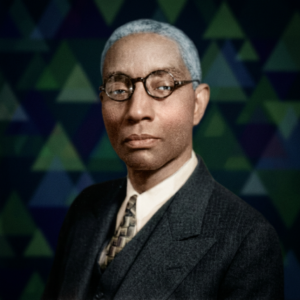 Through legal challenges and advocacy, Franklin and other Black attorneys were able to block the city’s attempt to enforce the restrictive building ordinance. This victory, though limited, was crucial. It allowed Greenwood residents to begin rebuilding their community, piece by piece. While the scars of the massacre would never fully heal, the ability to rebuild represented a form of resistance and resilience that defied those who sought to destroy the district entirely.
Franklin’s work in the aftermath of the massacre was not limited to rebuilding. He also played a role in pursuing justice for the victims, though in this arena the obstacles were immense. Insurance claims were denied, perpetrators were rarely held accountable, and the legal system often sided with those who had inflicted the violence. Despite these challenges, Franklin continued to advocate for his clients, documenting losses and seeking redress wherever possible. His efforts contributed to a historical record that would later become essential in understanding the full scope of the massacre and its impact.
Beyond Tulsa, Franklin’s legal career spanned decades and reflected a broader commitment to civil rights. He handled cases involving property disputes, civil liberties, and the everyday legal needs of African American communities. His work was part of a larger tradition of Black legal activism that laid the groundwork for the civil rights movement of the mid-twentieth century. While he may not have achieved national fame during his lifetime, his influence was deeply felt within the communities he served.
Franklin’s legacy is perhaps most widely recognized through his son, the distinguished historian John Hope Franklin, who grew up witnessing his father’s dedication to justice. The younger Franklin would go on to become one of the most important scholars of African American history, authoring the landmark book From Slavery to Freedom. In many ways, Buck Colbert Franklin’s life provided both inspiration and material for his son’s work, connecting personal experience to broader historical narratives.
 Yet Buck Colbert Franklin’s story stands on its own. It is a story of a man who chose to confront injustice not only with words, but with action. He understood that the law could be both a weapon and a shield, and he used it to protect his community at a time when protection was desperately needed. His decision to set up that tent office in Greenwood was more than a practical necessity, it was a declaration that the community would not be erased, that its people would not be silenced.
When Franklin died in 1960, the civil rights movement was gaining momentum across the United States. Though he did not live to see its greatest victories, his work was part of the foundation upon which those achievements were built. Today, his legal efforts, particularly in the aftermath of the Tulsa Race Massacre, are studied by historians and legal scholars as examples of courage, ingenuity, and perseverance.
Buck Colbert Franklin’s life reminds us that justice is rarely handed down freely. It must be pursued, argued, and defended, often in the face of overwhelming odds. His story is not just about survival, it is about rebuilding, resisting, and insisting on the right to exist with dignity.
And in that sense, Franklin did more than practice law. He helped write a chapter of American history that continues to demand our attention, our reflection, and our resolve.